

Thank you to everyone who responded to my previous video, "Karoline Leavitt is Ignorant on Tariffs." Your thoughtful comments have prompted this second video and substack in my series, "The Tough Truth About Tariffs." I want to highlight some of your comments and address confusion about tariffs, why Trump and others believe tariffs are beneficial, what their stated goals are, and highlight why these intended outcomes rarely materialize.
The most pervasive myth about tariffs is that they are paid by foreign countries, companies, or exporters. This is simply untrue. Tariffs are taxes paid by importers—American businesses and consumers—not by foreign entities. When Trump claims that "Canada has tariffs on the United States," he's partially correct, but these were retaliatory measures implemented after his 2018 tariffs, which triggered what we call "trade wars." And war is an apt analogy, since there are many casualties, yet no winners.
Trump was the first president to impose significant tariffs since Bush, who briefly implemented steel import tariffs in 2002-2003 before quickly removing them due to their negative effects.
As I continue this series, I'll show you which sectors are harmed by tariffs and examine historical data showing how manufacturing jobs were actually lost during the Trump years. This is particularly troubling because one of the primary arguments for tariffs is to revitalize manufacturing despite other superior alternatives. There are other ways to reboot American manufacturing than tariffs. Don’t fall for the false dichotomy of tariffs being the only answer.
Free Trade vs. Tariffs
Let me give you the punchline now before addressing your comments: Free trade, the opposite of tariffs, has dominated recent history for good reason.
It is widely known and documented from history that tariffs have a negative effect on economic growth and economic welfare1 while free trade and the reduction of trade barriers have a significantly positive effect on economic growth.
Free trade supports economic growth and creates productive jobs—the very goals that tariff proponents claim to pursue. Let me explain why by examining how economies develop. Economists typically divide economic development into three categories:
Agricultural stage
Manufacturing stage: This requires significant capital, infrastructure, and resources.
Services stage: The United States excels here as the world's largest service exporter.
International trade has become deeply integrated into our economic system and difficult to reverse. Most countries and economists favor free enterprise because it actually supports the stated goals of improving the economy and increasing productive jobs. As Milton Friedman noted, anyone can dig a hole and fill it again as a paid job, but is it productive? Does it add value to the economy or further the goal of enhancing American manufacturing?
Contrary to popular belief, the United States already manufactures products in virtually every strategic economic sector—steel, aluminum, lumber, energy, plastics, apparel, appliances, and automobiles. American manufacturing is well-represented across all industries.
Consumers can choose foreign products like Korean LG washing machines because they want to. When I needed a new refrigerator, I specifically chose American-made GE (manufactured in Kentucky) at a price comparable to LG.
But there's also a very complex interconnection of raw materials coming into the United States that are then used in American manufacturing.
Raw materials may enter the United States, be processed in Canada or Mexico, then return for final assembly by an American company. This interconnected system means tariffs don't just affect foreign companies—they impact American manufacturers who rely on imported components.
When we talk about tariffs, they are not a tax on the foreign country, the foreign company, or the foreign exporter—they're actually a tax on the importer, and it's passed down to the consumer.
Let me address something I mentioned in my video about Karoline Leavitt. Trump claimed he couldn't buy American-made windows in North Carolina when he needed a thousand windows. Apparently, he didn't look deeply enough, because there's a manufacturer that's been in business for 70 years in North Carolina making American-made windows. And it's not the only one.
There are American-made—not just American-made, but American-owned—window manufacturers throughout the United States. In fact, I need to have a window replaced, and I am buying American-made. I have that choice. And for someone who may not want to purchase an American-made product, why should they be penalized in a system of fair trade, free trade, and free enterprise by not having the greatest choice? Maybe they have a different budget or other reasons—it's their free choice.
Historical Evidence Against Tariffs
The historical record consistently shows that tariffs harm the economy. During Trump's 2018 tariffs, close to 100,000 jobs were lost across manufacturing sectors. This wasn't limited to specific industries—there was a ripple effect throughout the entire economy.
I'm certain that you, like me, want to see a robust economy. We want to see no more inflation, and tariffs historically—the record shows without deviation—that inflation increases and net jobs are lost. And tax experts agree that Trump’s tariffs will actually cost US households money.2
I want to keep manufacturing robust and help ensure America is a great place to do business. You may not have been around during the trade wars with Japan in the '80s and '90s when they were importing their products and Americans were buying them. But the dollars that the Japanese earned were actually reinvested in the United States, creating a net benefit. Rather than just looking at isolated pieces, we need to examine the whole picture.
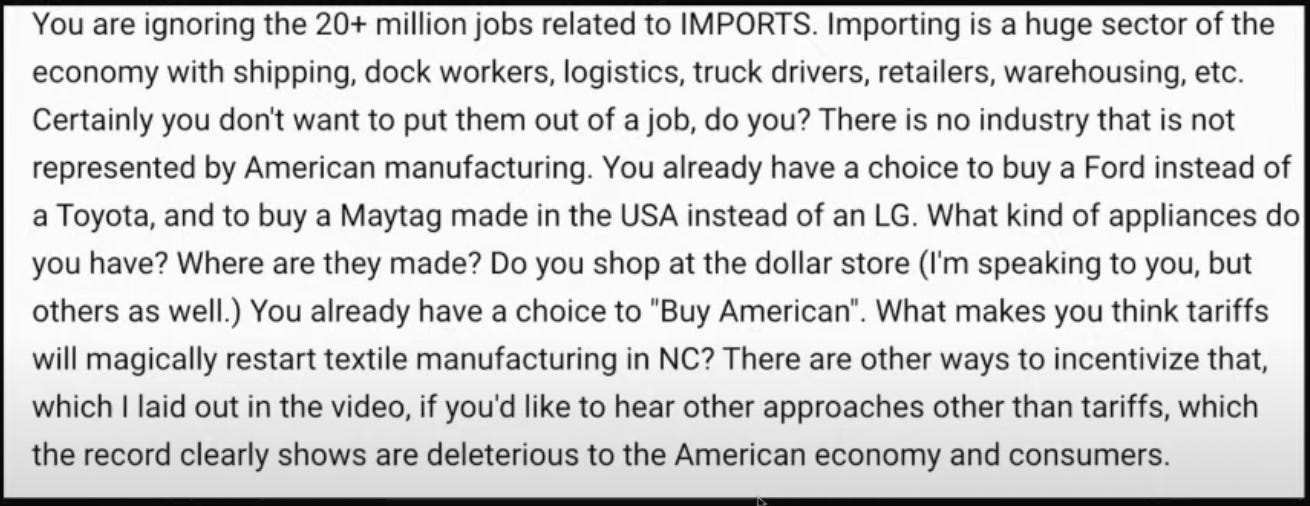
I also want to highlight the jobs directly supported by the import industry. When tariffs come on the scene and the import sector shrinks, those jobs are lost.
The Import Economy's Importance
Millions of American jobs directly depend on imports. These include:
Dock workers and port personnel
Shipping and logistics professionals
Warehouse staff and facility managers
Transportation workers
Retail employees
When tariffs reduce imports, these import-related jobs are jeopardized. Consider someone who invested in a warehouse near a port. They decided to get a mortgage to get the building. Then imports decrease because of the trade wars, and suddenly the warehouse is sitting half-empty — and then empty — and soon the warehouse investor cannot pay the mortgage. Then the warehouse sits empty and the landlord now has a vacancy, making it harder for the landlord to make his mortgage. Workers are laid off and unemployment rises. The economic impact is like a domino effect. of economic harm.
Imagine you live in Los Angeles and invested in a warehouse in Long Beach. You scraped your money together, maybe got a mortgage, and bought a warehouse because you know imports have to be stored somewhere before trucks deliver them to their destinations.
The trucking industry relies on imports. There are logistics managers. Now let's say Trump puts a tariff on imports, causing them to shrink. Suddenly your warehouse is empty, you can't pay your mortgage, you're underwater, and you're not making money in what you thought would be a good business. Then the landlord has an empty building, maybe with a mortgage of their own that they can't pay.
This example illustrates how intertwined international trade is and how robust the import sector truly is. This was my response to one commenter who was ignoring the 20+ million jobs related to imports.
Responding to Your Comments
Let me thank all of you for your thoughtful comments. Unlike Karoline Leavitt who got a bit heated under the collar, none of you were insulting—there was a fair exchange of information.
International trade, economics, law and politics is actually my background—I have a master's degree in international policy studies. I've studied international economics, international trade, and international law intensively. I've always been fascinated by why certain political systems and economic policies result in prosperity and well-being for individuals in certain countries while other political systems and economic policies harm individuals, manufacturers, and productivity in other countries. I've studied why the United States has been prosperous, with well-being and peace for so many people, and how no other political or economic system has worked to this extent.
Here's a great comment from Janine and my reply to her:
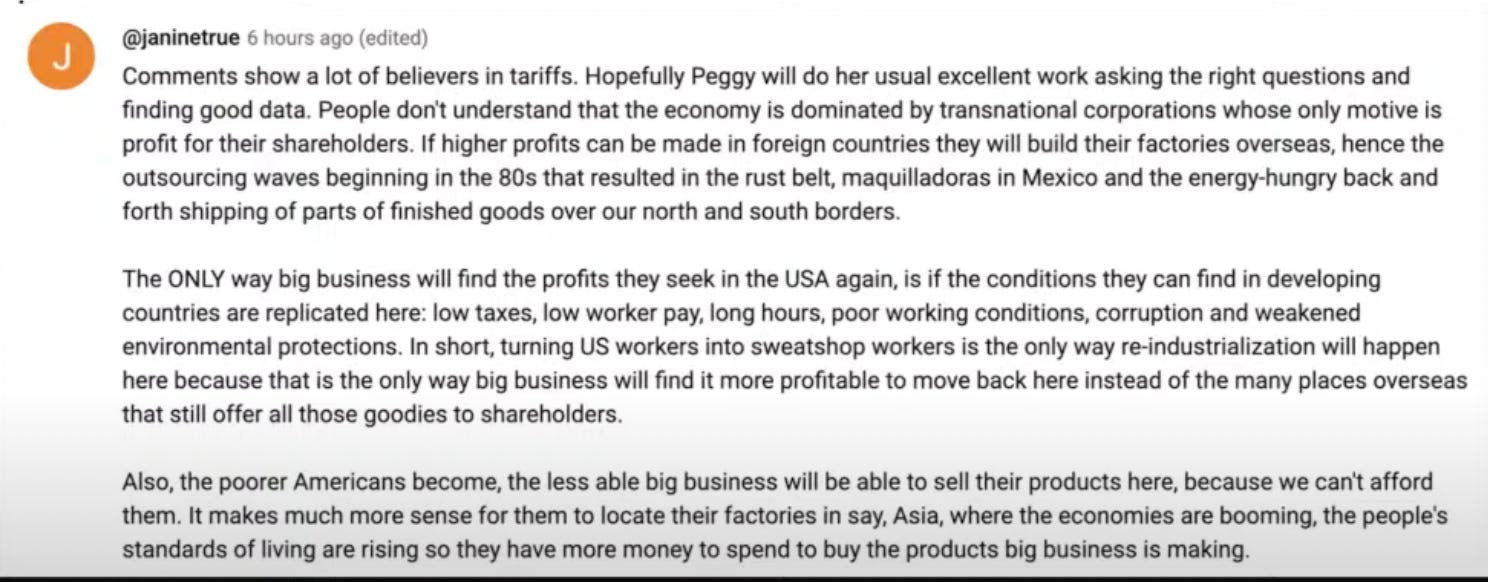
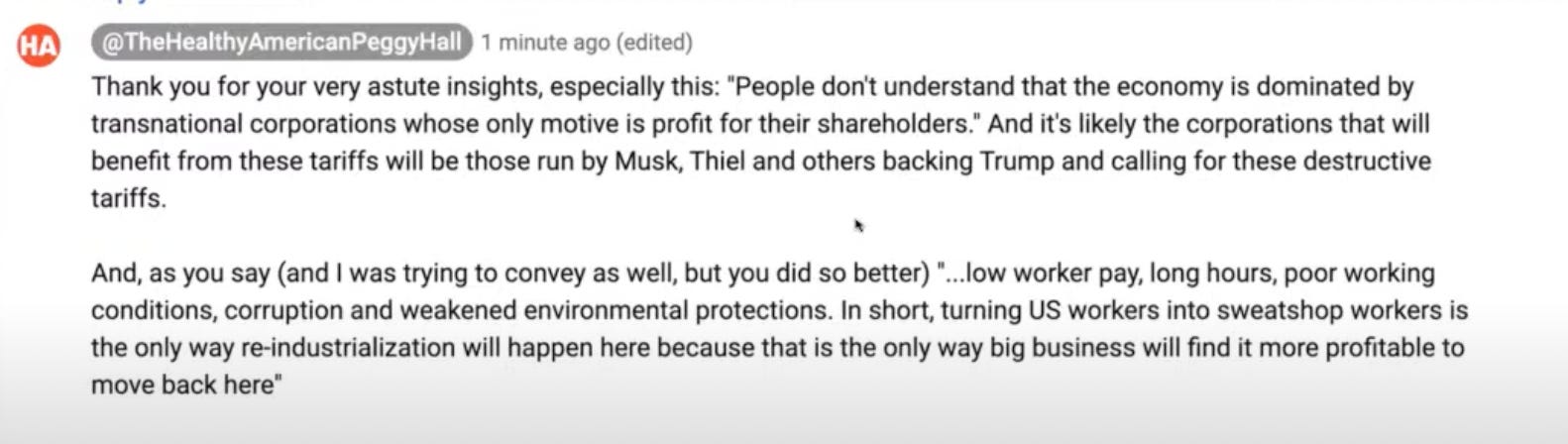
While I don't completely agree with Janine, she makes good points. The purpose of a company is to make a profit. Corporations and private businesses, unless they're nonprofits, aren't in business to do good—they provide services or products at a profit so they can make money. For publicly-held companies, their shareholders can make money too.
Companies cannot stay in business unless they make a profit. I'm certainly not in favor of companies making profits by cheating, stealing, or taking advantage of customers or employees. Companies should be run ethically, and sometimes (though not always) unethical companies go out of business.
Certain products are produced in certain countries because they have what's called a "competitive advantage." They can either make them more cheaply or, in the case of China, there are government subsidies where their government helps manufacturers make products and export them to the United States.
I think that's really what bothers Trump—that China has what he sees as an unfair advantage from government subsidies. It appears he wants to punish China; he says China is "ripping Americans off." There's also the issue of China stealing intellectual property, but that's completely separate from tariffs. I don't think any amount of tariffs would prevent China from stealing intellectual property.
What I want to emphasize is the need for companies to make a profit. They will source their materials in ways that allow them to be profitable.
Returning to Janine's comments, she stated that big businesses will only find profits in the US with "low taxes" which I agree with, but she also mentions "low worker pay, long hours, poor working conditions, corruption, and weakened environmental protections." While these conditions probably exist in some places, I don't think they're required for the United States to be profitable. Lower taxes and fewer regulations are definitely the way to go.
Let me know if you run a company or manufacturing operation. I actually manufactured my own products some time ago, before the 2020 hogwash. I produced my own skincare product called Youth Serum. It was a handcrafted, natural, healthy serum for your skin that people loved.
It was just me doing this—I wasn't running a large company—but I discovered how expensive and time-consuming it is to get even a small manufacturing operation up and running. It takes time, capital, and there are so many regulations and obstacles. Then there are corporate taxes, payroll taxes, and many other ways the government derives revenue besides just our income taxes.
Back then, I also started selling a handcrafted organic soap that people loved. However, soap is heavy and it costs a lot to ship it. And soap by and large does not have a high selling price. So it turned out for me, it did not make economic sense for me to make and sell and ship soap. It was not my competitive advantage. So I followed a basic strategy in business and decided to do more of what was working best: selling my Youth Serum. I’m using that example to extrapolate the business strategy to international trade: countries (and companies) should do more of what makes sense, of what people want, and what brings in the revenue. For the US, that means exporting agricultural products, steel, gas, oil, and services. The US is the leading exporter in the world when it comes to services like travel, consulting, financial services and more.
Government Revenue and Spending
Howard Lutnick, the Commerce Secretary who has a very colorful background, is making claims about replacing the IRS with the “external revenue service.” He's been described as a bully known as "the most hated man on Wall Street" because of how he ruthlessly took control of the investment bank Cantor Fitzgerald (on the deathbed of the founder, Cantor) and how is he was generally disliked by the employees.
Howie’s making the rounds saying they’re going to get rid of the IRS and have an "External Revenue Service." This is so far off base that I think he needs to go back to school—maybe he skipped his economics class.
Let me share some data with you:
In 2024, the United States collected $2.4 trillion in income tax—money that came from your pocket. That's roughly 50% of the total government revenue of $4.8 trillion. The rest comes from:
Payroll taxes (which I think could be reduced—this would immediately allow companies to have more money. I've paid payroll taxes; they don't go to my employees but directly to the government. Why should I pay the government because I have an employee?)
Corporate taxes (eliminate these or keep them at a consistent rate)
Capital gains taxes (if you bought a house and sold it for a profit, or invested in the stock market and made money)
Smaller amounts from things the government charges for, such as admission to federal parks
Look at these numbers: The government brought in $4.8 trillion but spent $6.75 trillion, leaving a deficit of $1.83 trillion.
Friends, I don't have a third-grader, but if I did, the third-grader would say this isn't a problem of income—it's a problem of expenditures.
Why doesn't the government stick to its shopping list and tighten the purse strings instead of harming the economy, harming American manufacturing, reducing jobs, increasing inflation, and increasing demoralization?
People are feeling reluctant to spend or go on vacation. Those running manufacturing companies may not be hiring because they're concerned this trade war will have negative effects. Hundreds of years of history have shown that tariffs never work—they never achieve their stated objectives. There are other ways to achieve these goals.
So Howie wants to take that $2.4 trillion and replace that revenue using an “external revenue service.”
Replacing the IRS with Tariffs Doesn’t Make Any Sense…
There are two major problems here…
First, people think that the governments or companies of China, Canada, and Mexico are going to be paying that tariff. You now know that's not true, even though Trump has said it many times and Karoline Leavitt has repeated it.
Not only do other countries not pay the tariff—you and I do. Furthermore, even if other countries did pay the tariff, the math doesn't add up.
Let's look at the numbers, shall we?
I like to work with facts, data, and numbers, so here they are: Currently in 2024, imports that we brought into the United States—companies and individuals—were valued at $4.1 trillion.
How are you going to get $2.4 trillion dollars out of $4.1 trillion imports???
Even if the foreign county did pay the tariff, that would be a 60% tariff on these imports!
That is not feasible by any stretch of the imagination.
Remember, there's a robust import sector that relies on imports. There are dock workers, shipping services, and warehouse staff.
As for exports, we exported services and goods valued at $3.9 trillion. That's a very small trade deficit—$4.1 trillion in imports versus $3.9 trillion in exports. Why don't we export more? That would really increase manufacturing, productivity, wages, and all of that. There are other ways of achieving these goals—that's the big picture I want to present.
The United States is the world leader in exporting services—we're the number one service exporter globally. We don't have a trade deficit in services. Why not focus on that? Why not focus on what you do well?
It’s a basic business principle: do more of what's working, not more of what isn't working.
The second is that we shouldn’t rely on getting products from other countries because they might cut off the supply. This is a valid argument, but when I researched this, I found that there isn’t one sector in the United States where we don’t have manufacturing capability.
But let’s flip that argument: if we want to maintain dominance in that field, wouldn't it make more sense to import as much as possible from other countries? That way, we're using up their resources, not our own.
I'm not suggesting we target other countries' resources, but if you're making a national security argument, it's logical to have them provide materials so you're preserving your own natural resources. You could also stockpile materials or find other ways to ensure national security isn't at risk.
My point is that there are better ways to increase manufacturing than tariffs:
Reduce regulations
Eliminate payroll taxes
Reduce taxes across the board so people keep more of their money
And guess what people do with that extra money? They spend it on products. When they spend it, manufacturers must make more, hire more people, and build more plants because demand increases. That's the beauty of low taxes and deregulation.
I don't know if you were around during the Reagan years—and I certainly don't agree with many of his policies—but he did implement lower taxes and less regulation, and the economy boomed.
So Howie’s ridiculous, ill-founded idea to replace the IRS with the ERS just doesn’t add up. Wouldn't it be wonderful if China could just pay for our income tax? It doesn't work that way! Howie, NO DEAL!
Think about your personal finances—I have to spend within my means. I don't keep debt on credit cards. I budget my money, time, and food. I want to be responsible. Why can't the government be responsible? They overspent by a tremendous amount, and increasing taxes and tariffs will never fix the problem. We need to limit spending instead.
So here's the question: How would you replace that $2.4 trillion in income tax with tariffs on imports? Our imports are only valued at about $4.1 trillion. To replace $2.4 trillion from import tariffs would require about a 60% or higher tariff rate! And remember, that money comes from you—it's paid to the Department of the Treasury and collected at the border by Customs and Border Protection.
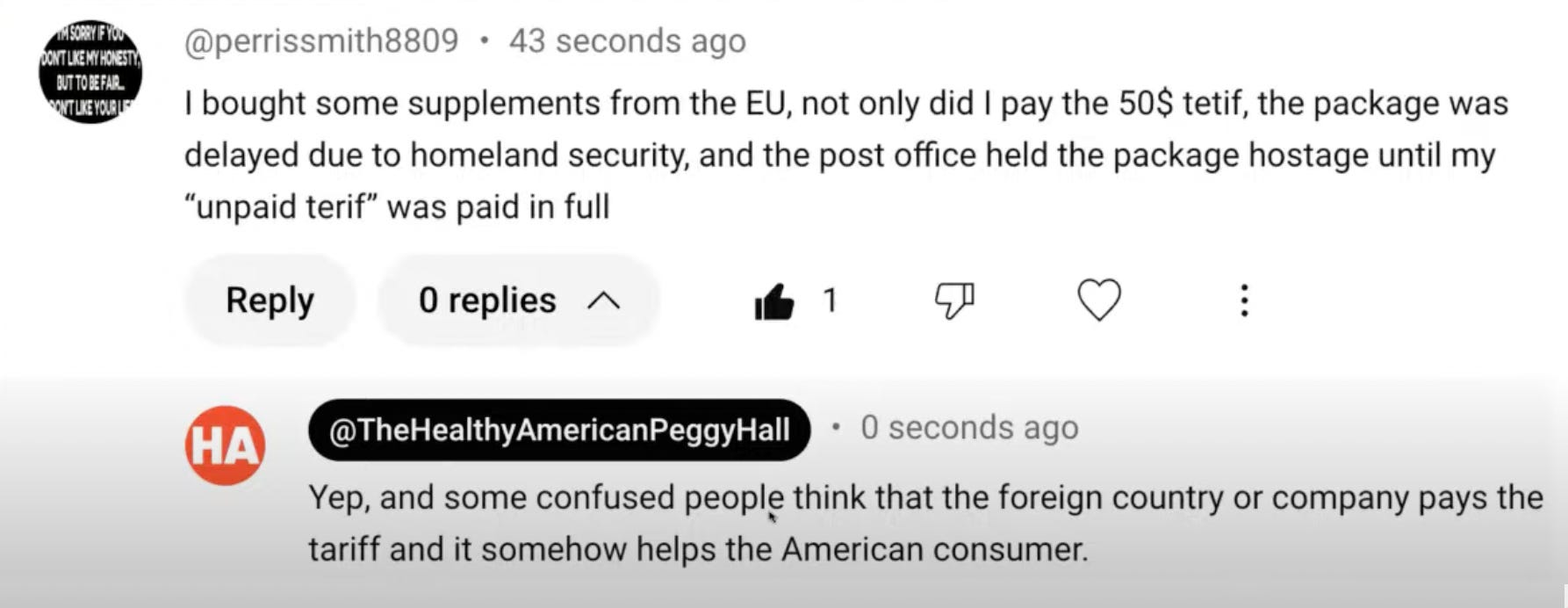
So comments like these are simply misguided:
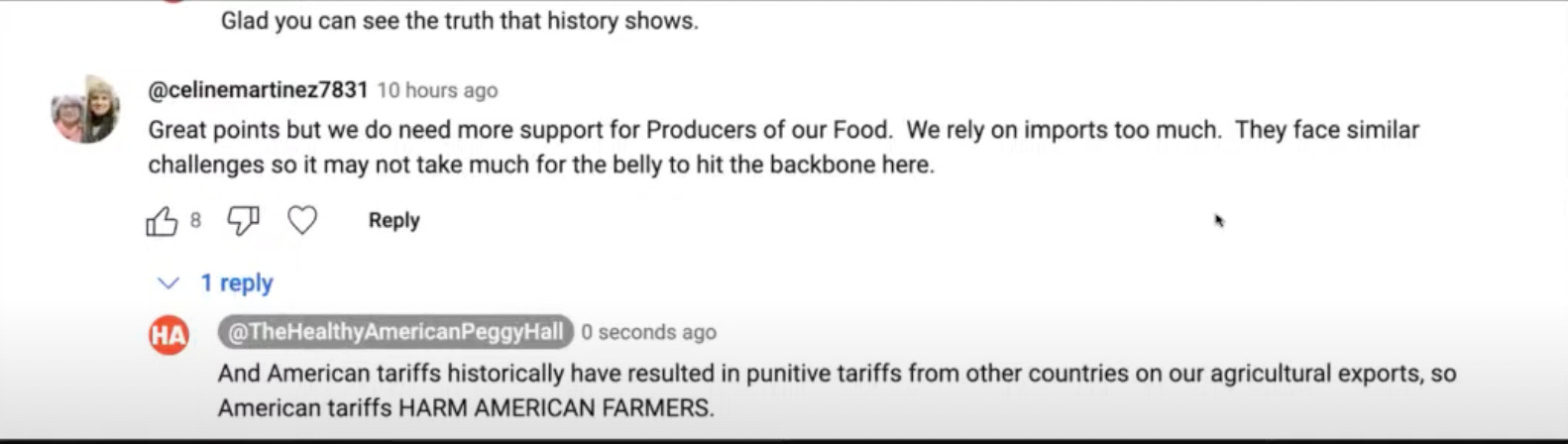

The IRS cannot go away entirely because even if we taxed American consumers (remember, tariffs are a type of tax on American consumers and manufacturers), it would have to be well over 50% to replace the IRS. That's not feasible due to the proven harms that tariffs inflict.
The only sectors where American manufacturing has notably declined are apparel, textiles, and printing. Most apparel now comes from China, Vietnam, and Indonesia; textiles from India; and printing from India and possibly the European Union. But you can still get these products made in the United States—it's just more expensive.
Every sector of the economy is represented by robust manufacturing in the United States, and you can buy American if you choose.
There's a historical record going back to our country's founding showing that tariffs are destructive to the economy. They drive up inflation, drive down wages, increase unemployment, and benefit virtually no one.
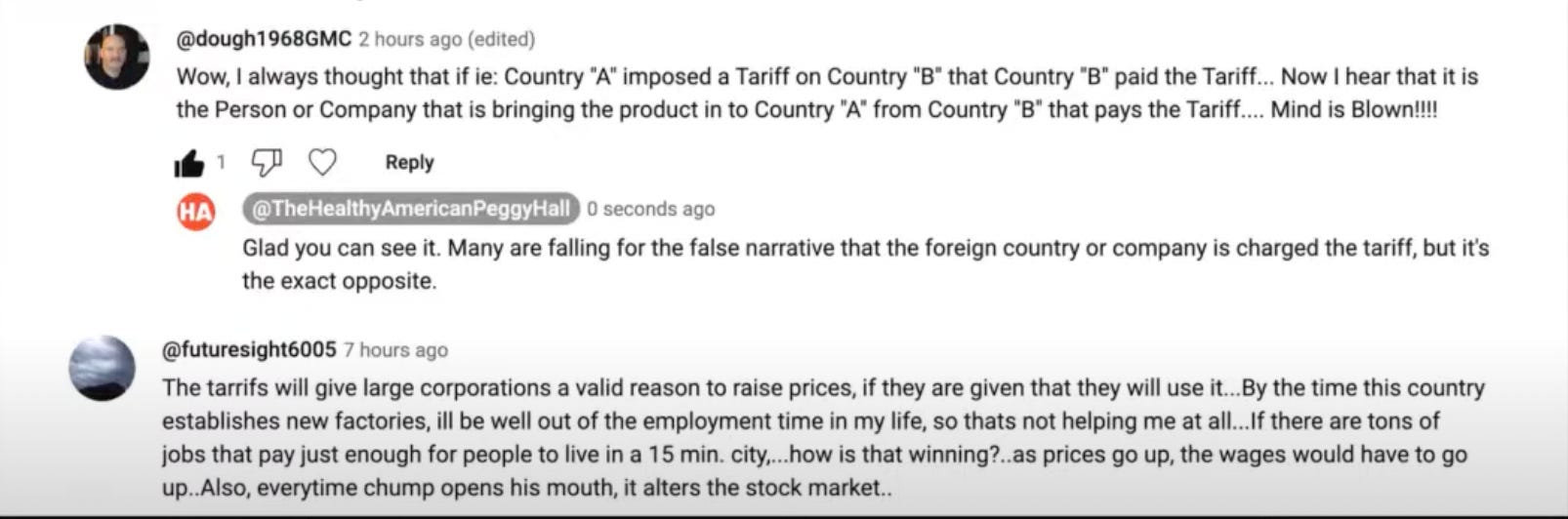
I think everyone understands how this works. Canada famously is saying they won't import our cream and chickens. The Canadian importing bureau is detailing everything that will have retaliatory tariffs applied and this will harm American food manufacturers.
If it was short-term pain for long-term gain, I might support it, and I think some people would too. But the historical record shows that as long as the United States has existed—and not just for the US but for other countries too—everyone is harmed by tariffs.
There are more productive, beneficial, and efficient ways to increase manufacturing and bring down inflation like allowing free trade and choice, and stop printing money out of thin air which drives up inflation.
Friends, the point of my video linked above was to respond to these common misconceptions and to clear up confusion. More and more people are starting to understand that tariffs are bad for the economy, workers, manufacturing, and trade relations. That's why we had free trade for so many years.
And I want you to check everything I am telling you. You’re savvy, you’re smart, and you can do the research as I am doing.
I'm fully in favor of the stated goals of tariffs, but unfortunately, tariffs don't work. Fortunately, other approaches can work: government spending within its means, lowering income taxes so people have more money to buy goods and services that actually improve the economy. We don't want to increase inflation by driving up prices, and we don't want people to lose jobs when we restrict imports.
This is only the second video in my series about tariffs, providing a general overview to hit some top points showing that historically, tariffs have hurt economies. That's why it's called a "trade war"—because there are casualties.
Next video and substack up: Why Trump is Wrong About Tariffs.
https://en.wikipedia.org/wiki/Protectionism
https://www.project-syndicate.org/commentary/trump-tariffs-would-tax-the-middle-class-benefit-the-richest-by-simon-johnson-2024-10


