

Thinking of traveling to Europe?
You might want to think again — especially if you are a person who values your privacy.
This month, the NON-OPTIONAL collection of your fingerprints and facial scan (together called biometrics) will be required for you to provide along with your passport when you enter and nearly any European country.
That means instead of getting a passport stamp, you’ll have your face and fingerprints scanned and entry/exit times recorded digitally….
And that data is stored for THREE YEARS.
The information I’m sharing with you comes from the European Travel Information and Authorization System, or ETIAS.

This collection of your biometric data (called ETIAS) is not the same as a visa.
The ETIAS website says this new system is for efficiency and to identify safety, security and health risks.
Did you catch that? This is for your safety. 😆
The European Union is implementing a new system, called ETIAS, to screen and track and control all travelers from visa-exempt countries who are entering European countries that are a part of what’s called the Schengen Zone.
The Schengen Zone comprises a swath of European countries that have agreed, as far back as 1995, to remove border controls whether by land, sea or air.

Good thing I’ve already traveled to Europe over the years… because I’m not about to comply with these outrageous (and mandatory) biometric data collection requirements.
Countries in the Schengen Zone
The Schengen Zone includes 27 countries, with more potential members in the coming years. Here is a list of the current participating nations that are a part of the Schengen Area. Whew! Luckily I’ve already done a bit of travel over the years, visiting the countries I’ve put in bold:
Austria
Belgium
Croatia
Czech Republic
Denmark
Estonia
Finland
France
Germany
Greece
Hungary
Iceland
Italy
Latvia
Liechtenstein
Lithuania
Luxembourg
Malta
Netherlands
Norway
Poland
Portugal
Slovakia
Slovenia
Spain
Sweden
Switzerland
What About The United Kingdom?
You’ll notice that England, Scotland and Wales are not on this list. That’s because of Brexit, when the UK exited the European Union.
Also, Ireland and Cyprus will still use traditional passport stamps.
When Does ETIAS Take Effect?
ETIAS is set to begin operations in April 2026.
Some countries are already testing out the new border control.
What Countries are Affected?
If you are a passport holder of any of these countries:
Travelers from the Americas
United States
Canada
Mexico
Argentina
Brazil
Chile
Uruguay
Travelers from the Asia-Pacific Region
Japan
South Korea
Taiwan
Australia
New Zealand
Other Eligible Countries
Caribbean (Antigua and Barbuda, Bahamas, Barbados)
Southeast Asia (Singapore, Malaysia, Brunei)
Eastern Europe (Ukraine, Moldova, Georgia)
Middle East (Israel, United Arab Emirates)
What Documents You’ll Need to Travel:
Once you’ve determined that you need ETIAS, you’ll want to prepare the correct documents and information to complete your application smoothly.
Here’s a quick checklist:
Biometric passport: Must be valid for at least three months beyond your intended departure from EU
Email address: Needed to receive notifications and your ETIAS authorization
Payment method: Use a debit or credit card to pay the EUR 20 fee
Your passport must be a biometric passport, meaning it contains a digital chip that can be scanned. Without one, your application may be denied or flagged during the border screening process.
Also, make sure your email address is valid and accessible, as all updates about your ETIAS authorization will be sent there, including approval, denial, or requests for additional documentation.
Can you Opt-Out?
There are very few exemptions to this. If you are a passport holder from one of the countries in the Schengen Zone, you don’t need to do the biometric data.
Longterm residents or visa holders from one of the Schengen nations are exempt.
Otherwise, if you want to visit one of these countries for travel or pleasure — or even just pass through the airport on your way to another place — you are required to comply with the biometric data scanning, collection and tracking.
Is it All That Bad?!
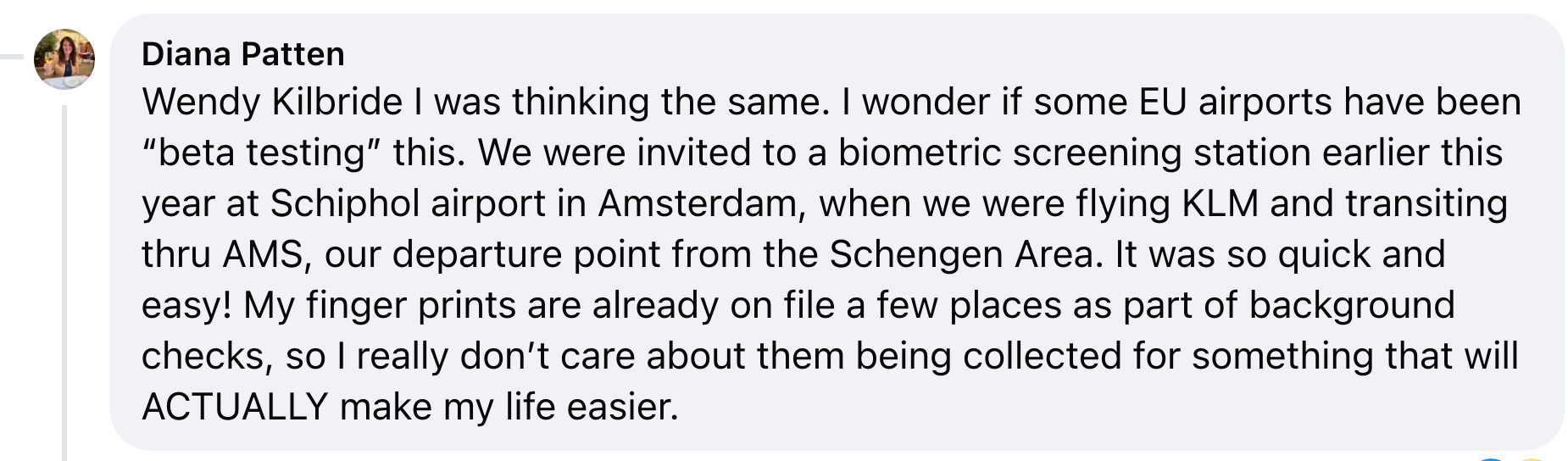
Some commenters online are saying:
“It’s faster and easier”
“The airport is already taking your picture the minute you enter”

So What Can You Do?
Travel before April 2026
Travel to the UK, Ireland, Cyprus or other countries not part of the ETIAS
Stand against this here in the US!
So What Do YOU Think?
How do you like being treated like a suspect?
How do you like having all your data available digitally for these European countries?
How do you like trading “security” for freedom?
What’s next? Restrain each passenger at their seat? After all, you could harm someone unless you are restrained.
Or better yet, why not restrict travel all together? Why not be issued a “day pass” that you can use at allotted time periods to leave your home — within a 15-minute radius, that is.
Coming to a town near you.
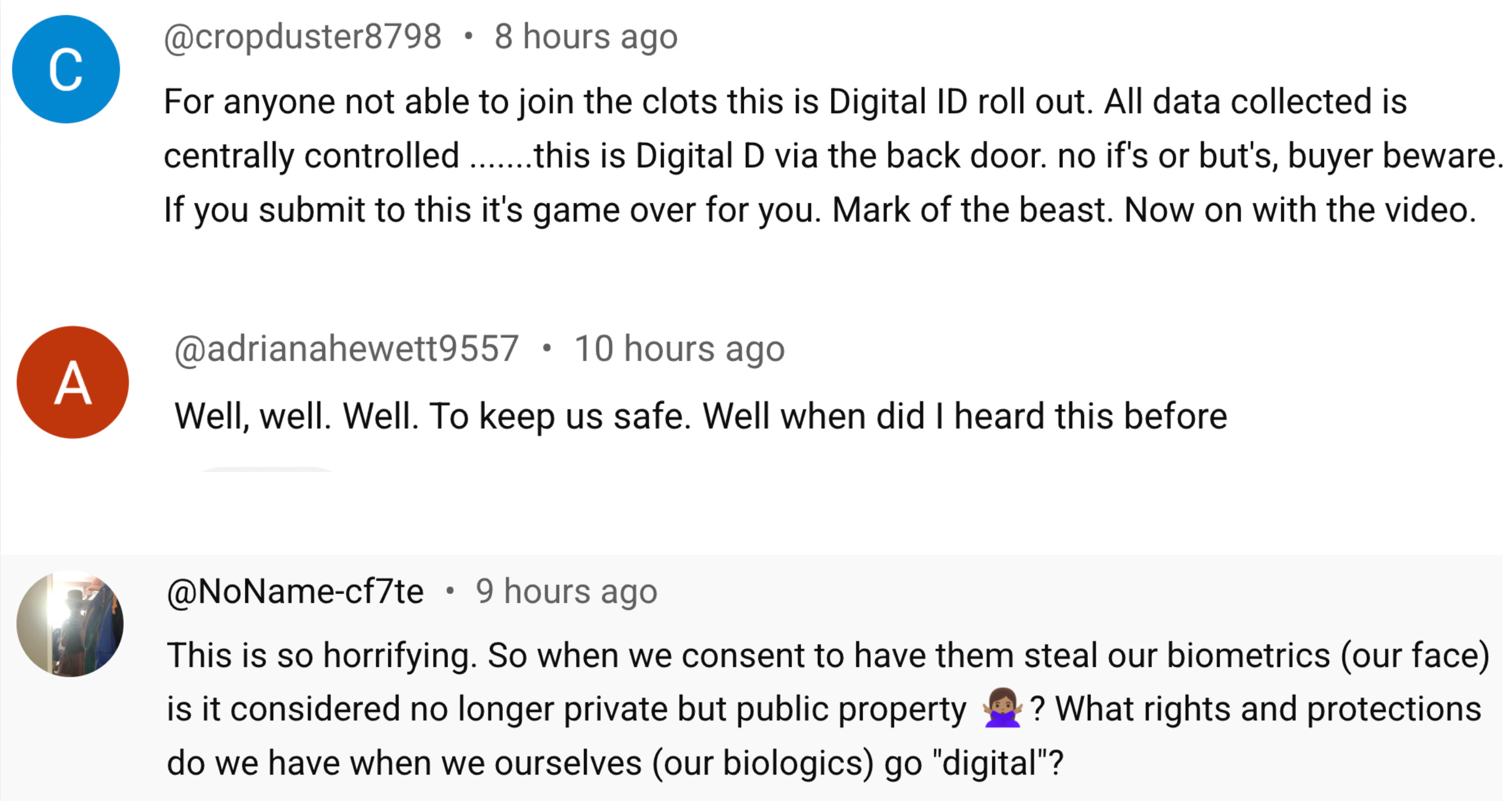
Italy has already implemented these requirements, effective Oct 12. So, my friend and I canceled our Nov. 18 trip to Rome. Fortunately, our airfare was fully refundable. These draconian measures may continue to creep, but they'll only get me kicking and screaming. Thank you for your work on behalf of all the folks, dear Peggy. 🙏
Hi Peggy, Thank you for reporting on this. I never heard of Biometrics until about a week ago. I went onto a financial platform to purchase financial products. In order to SECURE my account/assure/identify myself with this financial institution, a robotic spinning icon came up informing I had to abide by this identifying tool to move forward ..the identifying tool was called BIOMETRICS. I did not move forward with signing up or purchasing....the process did not sit well with me, and gave me an odd vibe .